Celebration – Queen of Hearts Party

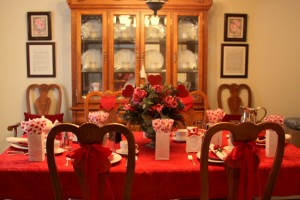
Queen of Hearts Party tableWith Valentine’s Day coming in February, it is never too early to brainstorm a party idea and I have a great theme – Queen of Hearts!  This theme could be used to set the table for a fun family dinner or an elegant tea luncheon or late dinner with close girlfriends.

Valentine’s Day is not always about romance and couples, it can also be a time to show love and support for your family and friends.  With our busy lives and everyone scattered to school, work and athletic activities sometimes we need to stop and spend some quite quality time together.  This would be a great occasion to celebrate with your family and show them how much you love them!  Fix a great dinner or maybe order take-out, it doesn’t matter, just take the time to talk and share together as a family.

Maybe there are other important people in your life that you want to show your love and support.  Another idea to celebrate Valentine’s Day is to invite other mothers in the neighborhood or your child’s school.  What a wonderful afternoon it could be sitting around the table with friends, enjoying a relaxed lunch and sharing the happiness or difficult times of motherhood.  (We’ve got to support each other!)  Or maybe you are single and want to get together with your girlfriends for a celebration.  Schedule a late dinner after work to eat a great meal and sit around a beautifully decorated table talking about love, men and dating … besides who wants to be alone on Valentine’s Day!

Basic supplies

  • Red tablecloth, size is determined by the table dimensions
  • White or ivory napkins for each guest
  • Rose floral centerpiece
  • Red rose buds for each place setting
  • Beautiful plates, glasses, utensils for each place setting
  • Red ribbon and red sparkle netting for chair back decorations
  • The photo shown above shows our dining room table set for a tea luncheon.

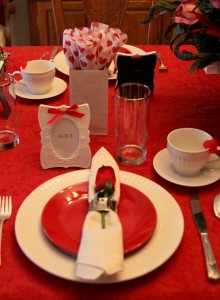
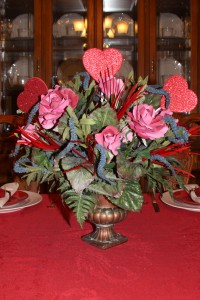
Queen of Hearts Party place setting    Queen of Hearts Party floral centerpiece

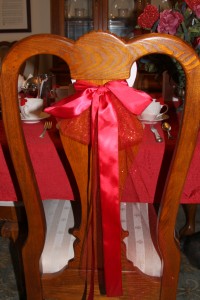
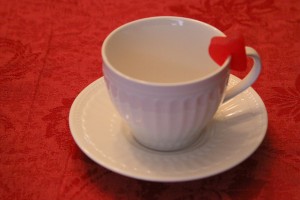
Start by setting the dining room table with a red tablecloth.  Set each place setting with beautiful plates, cup and saucers, glasses and utensils.  I used a large white dinner plate with a smaller red salad plate on top.  As a cute touch I cut a slice large jelly heart and attached it to the rim of the teacup.  Next, I used white napkins with a red rose bud tucked into silver napkin rings.  To complete each place setting, I used small white frames, tied with red ribbons for place cards.  To add festive look to the chair backs, I used two yards each of 1½ wide ribbon and 6 inch wide red sparkle netting tied into bows.  I also cut a large heart of red sparkle foam for each chair and attached it to the chair back.  Finally, to complete the table I wanted to enhance an existing deep pink rose floral arrangement, so I added red feather sprays and three red glittered hearts on sticks.  I think the table looks very festive and I think it is perfect for a Queen of Hearts tea luncheon for friends!

Queen of Hearts Party chair bow Queen of Hearts Party teacup with candy heart

Lewis Carroll’s Birthday

Charles Lutwidge Dodgson (Born: January 27, 1832 Died: January 14, 1989) was an English author better known under his pen name, Lewis Carroll.  His most famous book was “Alice’s Adventures in Wonderland” and the sequel “Through the Looking Glass”.

In 1856, Charles Dodgson (Lewis Carroll) became friends the Liddell family.  This friendship became an important part of his life and he enjoyed taking the children (Harry, Lorina, Edith and Alice) on trips into the English countryside and he would tell stories to entertain the children.   It was on one of these trips in 1862, that Dodgson came up with a story about a little girl who falls down a rabbit hole into a wonderful fantasy world.  Later, little Alice Liddell begged Dodgson to write the story and so he presented her with a handwritten, illustrated book called “Alice Adventures Under Ground” in 1864.

Dodgson eventually took the book to Macmillan Publishers, who promptly rejected the original name of the book.  Under the pen name of Lewis Carroll, the book was finally published in 1865 as “Alice’s Adventures in Wonderland” and the sequel, “Through the Looking Glass” was published in 1871.  It is believed that Dodgson used Alice Liddell as the inspiration for the books, even though Dodgson denied that he based the character on a real person there are in fact many references to her hidden in the pages of both books.  With the commercial success of the first Alice book Dodgson’s fame overwhelming grew as Lewis Carroll.  Queen Victoria enjoyed the first book so much that she wanted him to dedicate the next book he wrote to her, this never happened.  The Alice sequel sets a darker mood then the previous book and these changes reflect Dodgson’s life and the deep depression that he felt at the death of his father.

Dating back to 1923, the Walt Disney Company has had a long association with Carroll’s Alice books.  When the 21 year old Walt was working in Kansas City for the Laugh-O-Grams he produced a short film combining live action and animation called “Alice’s Wonderland”.  Eventually Walt moved to Hollywood and partnered with his brother to create the Disney Brothers Studio.  From 1924 to 1926 their new studio began producing a series of “Alice” short films.

These short films proved to be very successful and established Walt as a major film producer and the newly named Walt Disney Company began making feature length animation films.  In 1951, Disney released a new fully animated version of “Alice in Wonderland” that was based on both of Lewis Carroll’s Alice books. Focusing on the whimsy and fantasy of the story, the film cleverly sets Carroll’s prose into wonderful songs and is artistically designed with Mary Blair’s wonderful and very colorful backgrounds.  Originally the film was a financial disappointment and received criticism from the British fans of Lewis Carroll but Walt’s version was intended for a large family audience and not literary critics.  Several years later, in 1974, “Alice” became Disney’s first re-released animation film into movie theatres and it proved to be very successful the second time around.  With the introduction of the home video market, in 1981 Disney once again chose “Alice” as their first animated film release.  (This wonderful Disney animated film is probably the version of the Lewis Carroll story that we remember from our childhood!)

In 2010, the Walt Disney Studio released another version of “Alice in Wonderland”.  Directed by Tim Burton, this computer-animated and live action film stars Johnny Depp as the infamous Mad Hatter.  Using Carroll’s “Jabberwocky” poem as the main focus and inspiration, Burton hoped to create a cohesive story instead of a series of disjointed events of Alice wandering from one strange fantasy character to another.  The live action exterior Victorian scenes were filmed in England and the “green screen” special effects scenes, which are 90% of the film, were filmed at the Culver Studio in California.  This new Disney version proved to be very successful becoming the twelfth highest-grossing film of all time as of 2012.

Travel – Dearborn, MI

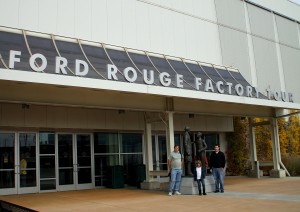
2009 Ford Rouge Factory Tour
As detailed in last month’s Travel post about Bronner’s Christmas Store, we took a fun weekend trip to Michigan in October 2008.  It was our first visit to Michigan and we decided to drive through Detroit because my husband and son wanted to see the Ford Assembly Plant in Dearborn.  When we arrived, we found out that we needed to purchase our tickets at the Henry Ford Museum.  We love to go to museums when we are on a road trips and after the factory tour we planned to spend some time there.  Below is a brief description of our visits to both the Ford Rouge Factory Tour and the Henry Ford Museum.

THE FORD ROUGE FACTORY TOUR

After purchasing our tickets for the tour we waited a short time for the bus to take us to the Assembly Plant.  No private vehicles are allowed to drive directly there and tours are only accessible from scheduled buses which depart from the Henry Ford Museum parking lot. The Ford Rouge Factory Tour is a self-guided tour that covers five different areas at the Assembly Plant.

To start the tour, we viewed two different films.  The first theatre is the Legacy Theatre which shows a 13 minute film that includes rarely shown footage from the Ford archives and is a great way to learn about Henry Ford and the history of the Ford Motor Company.  Next was another film in the Art of Manufacturing Theatre which has seats that swivel 360 degrees to view a presentation on seven huge screens positioned around the theatre.  The 14 minute film shown is an amazing multisensory experience that gives a virtual tour of the assembly process.  SPECIAL NOTE: The sights and sounds of this film can be rather intense and loud, so please be advised if you have small children that could get easily scared!
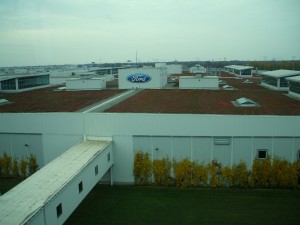
2009 Ford Rouge Factory Tour - Living roofAfter viewing both films, we were directed to take an elevator up to the Observation Deck where we got a panoramic view the Ford Rouge complex.  From here you can also see the “Living Roof” atop the Final Assembly building of the Dearborn Truck Plant.  In 1999, the 1.1 million square foot facility was given an environmental redesign and is covered by more than 10 acres of a low growing ground cover called sedum.  The sedum retains rainwater and the organic treatment system will clean and use over 20 billion gallons of the recycled rainwater annually for the facility.  The sedum also moderates the internal temperatures of the building.

When we were done on the Observation Deck, we took the elevator down for the Assembly Plant Walking Tour. (This is the part of the tour that my husband and son were excited to see!)  The self-guided 1/3 mile walking tour took us through the Ford Motor Company’s Dearborn Truck Plant where we were able to view the final F-150 Truck assembly line from an elevated walkway.  Along the tour there are interactive kiosks that explain the various stations of the assembly line and were a great way to learn more about the manufacturing process.

The final area of the tour is the Legacy gallery, where several different vehicles that defined the Ford Motor Company are on display.  At the time we visited the cars on display were the 1929 Model A, the 1949 Coupe, the 1955 Thunderbird, the 1965 Mustang and of course the F-150 Truck which we saw being put together on the assembly floor.  The Ford Rouge Tour was very interesting and we all enjoyed it, especially my husband and son!

SPECIAL NOTE:  It might be possible that the Dearborn Truck Plant assembly line would NOT be in full operation at the time you are planning to visit.  The assembly line suspends operation for daily breaks, shift changes, Saturdays and Sundays, holidays and normally during the first two weeks of July.  Please check the website for current information and production schedules at www.henryford.org

THE HENRY FORD MUSEUM

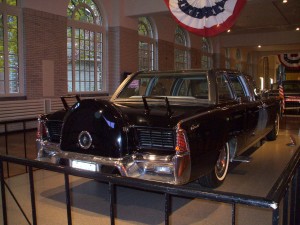
When we arrived to take the Ford Factory Tour, we thought that the Henry Ford Museum was going to be only about the Ford Motor Company.  We were pleasantly surprised to find that not only did the museum have a large collection of cars, trains and aircraft but they also had a wonderful collection of historical items.  A couple of the items that really stood out for us where three Presidential items: the 1961 Lincoln Continental Presidential car that John F. Kennedy was riding in Dallas, Texas on November 22, 1963 when he was assassinated, the chair that Abraham Lincoln was sitting in at Ford’s Theatre in Washington D.C. when he was shot, and George Washington’s camp bed that he used during the Revolutionary War.
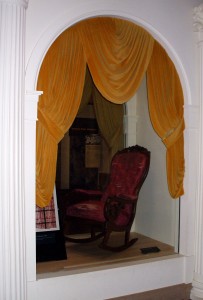
2009 Henry Ford - Kennedy car  2009 Henry Ford - Lincoln Chair

One very interesting exhibit was the Buckminster Fuller’s Dymacion house of the future prototype.  The architect wanted this house to be mass-produced, easy to ship and assemble.  At a cost $6500 in 1946, this aluminum house had two bedrooms built entirely in the round and was designed to be the strongest, lightest and most cost effective and space efficient home ever built.
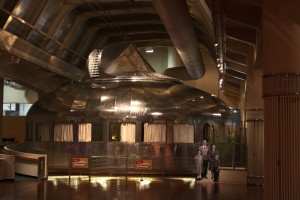
2009 Henry Ford - House of the Future

Another historical item was the Montgomery, Alabama bus that Rosa Parks was riding on December 1, 1955 when she decided not to give up her seat to a white man and move to the back of the bus.  This brave African American woman challenged the segregation laws and her arrest lead to the Montgomery Bus Boycott that sparked the beginnings of the civil rights movement.  As we were listening to the museum docent tell us the story about Rosa Parks, he invited our daughter to sit in the seat that Mrs. Parks refused to give up – it was a very powerful moment and a great history lesson!
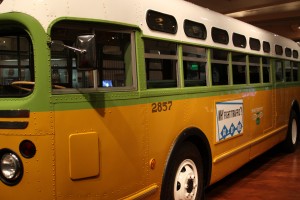
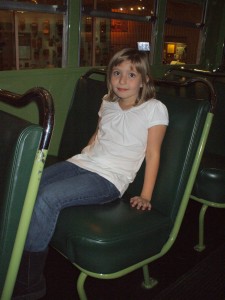
2009 Henry Ford - Rosa Parks bus    2009 Henry Ford - Cassie on Rosa Parks bus

When planning a trip to the Henry Ford Museum and a visit to the Ford Rouge Factory Tour, please check for current information regarding hours, admission fees and production dates at www.thehenryford.org

BRIEF HISTORY OF THE FORD ROUGE

Construction on the Ford Rouge Complex began in 1917 along the Rouge River in Dearborn, Michigan.  It was completed in 1928 and included 93 buildings in an area 1.5 miles wide and 1 mile long.  This huge complex has over 100 miles of railroad tracks, an electricity plant and an ore processing facility.  The Rouge boasts that it was able to turn raw materials into completed vehicles all within one complex.

The original building B, part of the legendary Dearborn Assembly Plant, first started producing Ford Model A vehicles in the 1920’s and continued with cars such as the Mercury, the Thunderbird and the Mustang. After the 1960’s, the Ford Motor Company began to build many factories across the country.   Eventually only the Mustangs were being produced at the Dearborn Plant and on May 10, 2004 the last Mustang rolled off the assembly line.  The historic Dearborn Assembly Plant was demolished in 2008 and was replaced with the current modern Dearborn Truck Assembly Plant which is producing F-150 trucks.

BRIEF HISTORY OF THE HENRY FORD MUSEUM

Originally called the Edison Institute for Henry Ford’s personal friend, Thomas Edison, the Institute was dedicated on October 21, 1929 a date which was chosen in celebration of the 50th anniversary of the first successful incandescent light bulb.  Some of the 260 people in attendance that day were Thomas Edison, Henry Ford, President Herbert Hoover, Marie Curie, George Eastman, John D. Rockefeller, and Orville Wright.   At the time the Institute consisted of two building which Henry Ford had moved from Edison’s Menlo Park, New Jersey and re-constructed in Dearborn, Michigan to look exactly like Edison’s laboratory was in 1879.  Eventually, the Institute was renamed the Henry Ford Museum after Ford’s death in 1947.

The Henry Ford Museum began as Ford’s personal collection of historical items that he began collecting as far back as 1906.  Ford wanted to showcase the American people and their ideas that changed our lives.  The museum is now one of the largest museums in the country.
A. A. Milne’s Birthday

Alan Alexander Milne (Born: January 18, 1882 Died: January 31, 1956) is the English author who wrote the books featuring the famous characters Winnie-the- Pooh and Christopher Robin. He wrote “When We Were Very Young” in 1924, “Winnie-the-Pooh” in 1926, “Now We Are Six” in 1927 and “House at Pooh Corner” in 1928.   I purchased these classic children books for my son, Christopher, when he was a child for the obvious reason that he shared the name of character in the book. When my daughter was born her Great Aunt also bought her the books. I have always loved the stories and they make an excellent gift for a baby shower. It is never too early to build a child’s own library of books!

The character of Christopher Robin was named after the author’s son, Christopher Robin Milne, who had received a stuffed bear as a first birthday gift.  This stuffed bear purchased in Harrod’s Store in London inspired one of the book’s main characters and was originally given the formal name “Edward”.  Later the real Christopher changed the bear’s name to Winnie for a bear in the London Zoo.  The story goes that there was a real bear cub that was bought from a hunter by a Canadian lieutenant.  He named the bear “Winnie” after his hometown of Winnepeg, Manitoba.  The bear eventually became the regiment’s mascot and was brought to England during World War I.  When the regiment went to fight in France during the war the bear was officially given to the London Zoo and quickly became the zoo’s most loved attraction.

The real Christopher Robin had a collection of stuffed animals and these inspired the characters in the storybooks, such as: Tigger, Eeyore, Kanga and Roo.  The other characters named Owl and Rabbit were added later in the Disney animated movies.  These original stuffed animals of Christopher Milne are now on display at the New York City Public Library.

Ashdown Forest in Sussex, England was the inspiration of many of the locations in the Milne’s book.  The footbridge where “Poohsticks” was played by Christopher Milne actually exists and is a tourist attraction where people play the game with sticks gathered from the nearby forest.  E.H. Shepard’s wonderful illustrations were drawn from this real place and his sketches of the beautiful forest scenes are in the Victoria and Albert Museum in London.

In 1966, Walt Disney Studios released the first of a series of Winnie-the-Pooh animated featurettes, “Winnie the Pooh and the Honey Tree”, followed by “Winnie the Pooh and the Blustery Day” in 1968 and “Winnie the Pooh and Tigger, Too!” in 1974.  These three featurettes were combined into one movie in1977 appropriately called “The Many Adventures of Winnie-the-Pooh”.  Disney continued to produce more animated movies and television shows featuring the characters of Winnie-the-Pooh but one of our favorites is the 2005 movie, “Pooh’s Heffalump Movie”.


There has been quite a bit of controversy considering the legal rights to Milne’s Winnie the Pooh.  Milne was very liberal in granting his rights to the book’s characters to more than one entity.  In the United States, Dutton Publishers acquired the exclusive rights to the books.  Stephen Slesinger also acquired exclusive rights and beginning in 1930 he created the distinctive colorful images of Pooh wearing a red shirt.  In 1961 the Milne estate, now known as the Pooh Properties Trust, licensed exclusive film rights to Disney.  Over the course of the following years Slesinger filed suit and a court battle began.  Eventually the district court found in favor of Slesinger as did the U.S. Court of Appeals.  In 2006 the U.S. Supreme Court refused to hear the case and sustained the Appeals Court ruling.

In 1991, Kenny Loggins released a wonderful album of children’s songs called, “Return to Pooh Corner” featuring a lovely song by the same name.  I bought this album when my daughter was born and played it for her almost every night at bedtime and she would go to sleep listening to the CD.  She loved the songs and still remembers them!

SPECIAL NOTE:  If you are looking for a special baby shower gift this album by Kenny Loggins would make a sweet present.  I would suggest combining the “Return to Pooh Corner” CD with the DVD of “The Many Adventures of Winnie- the- Pooh” and a beautiful four book set of the A.A. Milne books.  Put all the gifts into a basket along with a stuffed Winnie-the-Pooh bear – what an amazing gift that would be!!

Danny Kaye’s Birthday

Danny Kaye (Born: January 13, 1913 Died: March 3, 1987) was born David Daniel Kaminsky.  He was a great actor, singer, dancer and comedian.  In his professional career he was known for his physical comedy and silly songs.  He made 23 Hollywood movies from 1935 to 1969.  He had his own radio program from 1945 to 1946 and television variety show from 1963 to 1969.  Danny Kaye was a talented performer and has three stars on the Hollywood Walk of Fame for his work in radio, film and music.

Danny Kaye was also known for his charity work for the United Nations and in 1954 he became the first ambassador of UNICEF.  As an example of his varied interests, from 1977 to 1981 he was part owner of the Seattle Mariners baseball team.   He continued to work in television with several guest starring roles and hosted TV specials in 1980 for Disneyland’s 25th Anniversary and in 1982 for the opening celebration of EPCOT.  In 1983 he was knighted by the Queen of Denmark for his portrayal of Hans Christian Andersen in the 1952 film.  In 1984 he was the Grand Marshal of the Tournament of Roses Parade and also received the Kennedy Center Honor for his work in radio and film.

In February of 1983 Danny Kaye had a quadruple bypass heart surgery and died in March 1987 from a heart attack.  He is buried at Kensico Cemetery in Valhalla, New York.  At his gravesite is a special bench carved with symbols to show his varied interests, such as a piano and musical notes, an airplane, a flower pot and a baseball, bat and glove inscribed with his name and dates of his birth and death.  It is a fitting tribute to his multi-talented man.

As a child of the 1960s, I grew up watching Danny Kaye movies and when my children got older we watched them together.  My three favorite movies are “Hans Christian Andersen” (1952), “The Court Jester” (1956) and “White Christmas” (1954).  The first two are wonderful movies to watch with the family and “White Christmas” is a holiday classic that we watch every holiday season.


I highly recommend these three movies as a wonderful example of Danny Kaye’s acting and musical talents.  As I mentioned before, these movies are great entertainment and would be great to watch with the family especially little children.