Celebration – President’s Day (Part Two)

A good way to celebrate President’s Day is by watching some great movies about presidents.  Two of our favorite presidential movies are about fictional presidents, “My Fellow Americans” and “The American President”.  Here is a suggestion to make President’s Day a special evening: order a pizza, make a salad and enjoy a delicious dinner with the family, then get comfortable on the sofa and watch the movies.  Please be advised: both these movies are rated PG-13 and might not be suitable for younger children.

To continue with the theme of fictional presidents, one of our favorite television series is “The West Wing”.  This show is so well written and the dialog is fast-paced and we also enjoy the balance of comedy and drama; it keeps the series fun and exciting.  I know you can’t watch all 154 episodes in one night, but this is one of those television series that is worth watching again!

My Fellow Americans

This 1996 comedy movie is about two fictional ex-presidents, President Russell Kramer (Jack Lemmon) and President Matt Douglas (James Garner).  These two former rivals of opposite political parties are drawn into a scandal by the current President William Haney (Dan Aykroyd).  Presidents Kramer and Douglas become reluctant allies on a desperate search for evidence to establish their innocence in the “Olympia” scandal and they narrowly escape into the Appalachian Mountains as they are pursued by government agents.  These reluctant allies are on a desperate search for evidence to establish their innocence in the “Olympia” scandal. Surprisingly, as these two former presidents travel through Middle America; they meet illegal immigrants, a homeless family and they even find themselves marching in a gay pride parade.  Wait for the plot twist near the end of the movie and the fun ending to the movie.   Supporting cast includes John Heard as the bumbling Vice President Ted Matthews, Wilford Brimley, Lauren Bacall, Sela Ward, Everett McGill and Bradley Whitford.

My Fellow Americans Trivia

  • The title of the film comes from the common phrase used as a traditional opening of presidential speeches.
  • The movie was originally supposed to be a Walter Matthau and Jack Lemmon movie.  Unfortunately due to illness, Matthau was replaced with James Garner instead.  For this reason the film was unofficially known on set as “Grumpy Old Presidents”
  • Some memorable lines for the movie:
    “Hail to the chief, he’s the chief and he needs hailing. He is the chief, so everybody hail like crazy…”
    “Well, as usual, the Republican comes up with a plan while the Democrat just aimlessly wanders in the woods”

The American President

This 1995 romantic-comedy movie is directed by Rob Reiner (he also directed “The Princess Bride”) and written by Aaron Sorkin (he created “the West Wing” television series.  In this movie fictional President Andrew Shepherd (Michael Douglas) is a widower with a young daughter who is preparing for his upcoming re-election.  Based on his high approval rating and on the advice of his chief of staff A.J. MacInerney (Martin Sheen), they attempt to pass a controversial crime control bill before the State of the Union Address.  Meanwhile, President Shepherd meets an environmental lobbyist Sydney Ellen Wade (Annette Bening) who has recently moved to Washington D.C. who has her own agenda to get legislation passed regarding reduced carbon dioxide emissions.  Spontaneously President Shepherd invites her to attend the upcoming State Dinner for the President of France.  A romance soon develops and causes problems when a political rival Bob Rumson (Richard Dreyfuss) uncovers some damaging information about Sydney’s past and tries to derail President Shepherd’s re-election plans.  The movie ends with the State of the Union Address.

The American President Trivia

  • Originally Robert Redford was cast as the President but he was replaced when he had a falling out with the director, Rob Reiner.  Also at one point, Emma Thompson was considered for the role of Sydney.
  • Michael J. Fox, who plays Lewis Rothschild an assistant to President Shepherd, based his character on George Stephanopoulos.  Stephanopoulos was the communications director during the 1992 Presidential campaign of Bill Clinton, when Clinton was elected Stephanopoulos became the White House Communications Director, then a Senior Advisor for Policy and Strategy before he left in 1996.

The West Wing television series

“The West Wing” television series ran for seven seasons on NBC from September 1999 to May 2006.  The show takes place during the administration of the fictional President Josiah Bartlet (Martin Sheen) and centers on daily work of the West Wing of the White House which is where the Oval Office of the President is located and also the offices of the presidential senior staff.  “The West Wing” ensemble cast centers on the President, the First Lady Abigal Bartlet (Stockard Channing), Chief of Staff Leo McGarry (John Spencer), Deputy Chief of Staff Josh Lyman (Bradley Whitford), Communications Director Toby Zeigler (Richard Schiff), Deputy Communications Director Sam Seaborn (Rob Lowe) and Press Secretary C.J. Cregg (Alison Janney).  Numerous secondary characters appeared throughout the show’s seven seasons.  Generally the storylines involved the main characters with some advancing into other positions in the fictional presidential staff, some characters left and other characters where added over the course of the series.  During the series final two seasons, the plots involved both the final years of President Bartlet’s presidency and the campaign and primary elections for the next president.

“The West Wing” received critical acclaim and many entertainment awards.  What kept the show interesting were the fast paced, humorous scripts filled with intense dialog brilliantly written by Aaron Sorkin.  The show developed a technique known as the “walk and talk”.  These scenes generally involved long conversations started between characters as they are walking from one location to another with various characters joining or leaving the conversation as they move through the halls of the West Wing.

The West Wing Trivia

  • The series was supposed to center on the presidential senior staff with the fictional President Bartlet (Martin Sheen) originally scheduled to appear in only four episodes per season but after the pilot was filmed it was determined that he was needed as a permanent character.
  • Martin Sheen had an injury to his arm when he was born and has a very unusual way of putting on his jacket and this unique style was incorporated into the character of President Bartlet.
  • A portrait of Theodore Roosevelt, a Republican President, traditionally is hung in the Roosevelt Room in the West Wing of the White House during a Republican administration.  During a Democratic administration a portrait of Franklin Roosevelt, a Democratic President, hangs in the room.  In the Roosevelt Room of President Bartlet’s White House both portraits are used.
  • During the first season, reporter Danny Kincannon brings C.J. a live goldfish in a bowl.  The goldfish/bowl became a permanent part of C.J. office and whenever it appears in later episodes, the decoration in the goldfish’s bowl changes to match the theme of the episode.
  • Sadly, actor John Spencer, who played Leo McGarry, died from a heart attack in December 2005, about a year after his character experienced a nearly fatal heart attack on the show. The cast and crew were devastated and a brief memorial message from Martin Sheen was broadcast before the episode “Running Mates”, which was the first new episode that aired after Spencer’s death. The loss of the character of Leo McGarry was addressed in the episode “Election Day”.
Celebration – President’s Day (Part One)

Continue reading

Celebration – Valentine’s Day

Valentine’s Day … the holiday of love and romance!

Valentine’s Day is celebrated every year on February 14 in many countries around the world. It is a day to remember and honor your loved ones with cards, flowers, candy, etc. I personally think that we should be celebrating our love every day of the year and not just one single day. I know that I feel very happy when my husband brings me flowers unexpectedly … a guaranteed smile on my face!! But, how did this romantic holiday start?

The legend of the patron saint, St. Valentine, goes back many centuries and the origin of the tale has become something of a mystery. One legend says that Valentine was a priest during the third century in Rome. At the time, Emperor Claudius II decided single men made better soldiers and prohibited them from marriage. Valentine defied the Emperor and continued to perform secret marriages for the soldiers. The Emperor discovered this, Valentine was sent to prison and the Emperor ordered his execution. While Valentine was imprisoned he is said to have healed the daughter of his jailer and before he was executed, he sent her a note and signed it “from your Valentine”. There are several other stories about Valentine, but he is always portrayed as a sympathetic, heroic and romantic person.

In the Middle Ages, Geoffrey Chaucer wrote a poem, “Parlement of Foules”, which is said to be the first recorded association of Valentine’s Day with romantic love. By the 15th century, Valentine’s Day had become an occasion for lovers to express their love by presenting flowers, offering confectionery delights and sending handwritten sentimental notes, known as valentines, to their loved ones. By the 19th century, paper valentines became so popular in Victorian England that factories started mass producing greeting cards with popular symbols of love such as: the heart, doves or lovebirds and Cupid with his bow or arrows.

In the United States, it is estimated that 190 million valentines are sent each year making Valentine’s Day the second largest card holiday. According to those statistics, women purchase and send 85 percent of those valentines. Those numbers do not include the mass-produced character themed valentines that students give to each other and their teachers. The idea of exchanging cards has extended into gifts such as: roses, heart-shaped boxes filled with an assortment of chocolates and in the 1980’s the diamond industry began to promote giving jewelry to that special someone! Now, with the Internet, it is estimated in 2010 that over 17 million e-valentines were sent.

l remember as a child, sending and receiving valentines in grammar school! Luckily, my mother saved us boxes filled with our school papers, art projects and within those boxes were the valentines cards from my fellow classmates. It is fun to see the old fashioned style of these 1960s valentines and remembering all those friends from so long ago. I kept up that family tradition of saving the valentines for my kids. For my daughter I found a cute Valentine-themed box and this is where she has saved her valentines from school. Every year she likes to sort through them and remember her old friends back in California and her new friends here.

Do you do any special ways to celebrate Valentine’s Day? I would love to hear from you, send me a comment with your traditions or ideas.

Celebration – Last Minute Valentine’s Day Ideas

Sometimes with our busy lives the holidays come too soon and we are not prepared!!  Valentine’s Day is one of those times; it comes after Christmas when most of the time in we have just finished packing the holiday decorations and moving them into storage. Well, Valentine’s Day is quickly approaching and here are some ideas for last minute projects that are easy to make and take very little money.

“Showered with Love”

This a great project to do with the kids!  All that’s needed are a couple of bags of balloons, I used red and hot pink balloons, but you could also add white balloons.  A variety of colors keeps the display visually interesting.  You can blow up all the balloons in advance and store them in a place hidden from the person you are surprising.  You can fill the balloons with fun messages.  Just write the notes on small pieces of papers tightly roll them up and insert them into the balloons.  Fill the shower stall with the balloons and close the shower curtain.  Tape a large note to the shower door that says, “Good morning!  You have been showered with love!” It is a lot of fun and the kids will love writing the notes and surprising the person!!

This is also a great idea to surprise someone with on a special birthday!!  Just attach a note to the shower door that says, “Happy Birthday! You are showered with love!”

“Heart Attack”

This is another great project for your spouse, family or friend.  The supplies needed for this project are simply some construction paper or scrapbook paper and tape.  You can get fancy; I used red glitter foam left over from the Queen of Hearts Party.  Cut the paper into the shape of different size hearts. You can use red, pink and white for a great look.  Be sure to include one larger heart that says, “With love from your name(s).  Attach the paper or foam hearts with tape and please be sure not to obstruct the front window.  Now, you have one of two chooses: decorate the special person’s car at their home either parked inside the garage or outside on the driveway or street.  Where you decorate the car should be determined by the local weather because snow or rain will definitely affect the paper hearts, please keep that in mind when you are planning this project!

This is another project that could be used for a birthday or anniversary, you can use others colors of paper or foam hearts for the decorations.

A Trail of Kisses

Here is a fun project to do for your kids or adults, too!  Buy a bag of Hershey’s kisses, any flavor.  Leave a trail of kisses on the floor leading to a special gift, maybe a stuffed animal, Barbie, Lego set, etc.  Decide if you want one special gift or several, it is up to you!  It’s easy; the child would follow the trail of kisses to get to the special present!

SPECIAL NOTE:  Please be advised that chocolate can be very harmful for dogs, so take caution when you are doing this activity, we don’t want any dogs getting sick.

Travel – Springfield, Illinois (Part Two)

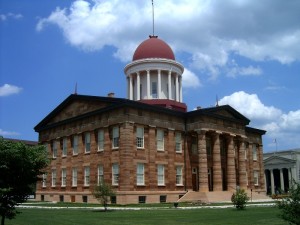
Springfield, IL Old State CapitolIn honor of Abraham Lincoln (Born: February 12, 1809 Died: April 15, 1865) and President’s Day in February, I would like to share some of the historic places we have visited in Springfield, Illinois.  Due to the numerous Lincoln historic sites in Springfield, I have divided the content into two separate posts.  The first post, Springfield, IL (Part One), covers the Lincoln Library and Museum.  The Lincoln Library and Museum are located within walking distance from two additional Lincoln historic sites, the old State Capitol building, and the Lincoln-Herndon Law Offices.  This second post, Springfield, IL (Part Two), covers the old State Capitol, the Lincoln-Herndon Law Offices and also the Lincoln Home and the Lincoln Tomb which are located within any easy drive from downtown Springfield.
The Old State Capitol

From 1820 to 1837 the capitol of the state of Illinois was located in the small town of Vandalia, Illinois which is located in the southern part of the State.  Then in the 1830s the northern portion of the state was opened to settlement and there was pressure to relocate the state capitol closer to the geographic center of the state. A group of nine Illinois lawmakers, including a young lawyer named Abraham Lincoln, lobbied to have the state capitol moved to Springfield.  In 1837 their efforts proved successful, a law was passed and with a two year transitional period the state capitol eventually moved to Springfield in 1839.

Built on Springfield central town square, the Greek Revival-style building was constructed from local yellow Sugar Creek limestone.  When Lincoln was a lawyer, he tried many cases before the Illinois Supreme Court.  In 1858 he delivered the famous “House Divided” speech in Representatives Hall when he was campaigning for the U.S. Senate.  Lincoln lost the Senate race to Stephen Douglas but two years later he was nominated and won the Presidency of the United States.  Sadly, four years later he was assassinated and Lincoln’s body returned to the Capitol building to lay-in-state before his burial in Oak Ridge Cemetery.

By the 1870s the building was becoming too small for the growing Illinois State government.  The current State Capitol was built four blocks to the southwest and the Old State Capitol became the local county courthouse.  From 1966–69, preservation work was done on the building and it was restored to how it appeared in 1861 when Lincoln left for Washington D.C.

For travel information on the old state capitol please visit their website at  www.illinoishistory.gov/hs/old_capitol.htm.

The Lincoln-Herndon Law Offices

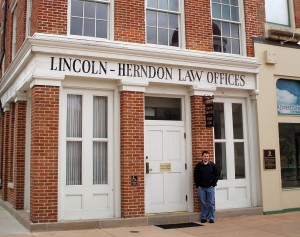
Lincoln-Herndon Law OfficesIn 1844 when Abraham Lincoln’s first law partner Stephen Logan left the firm, Lincoln hired a junior partner named William Herndon.  Lincoln and Herndon prepared cases for the Federal courts and the Illinois Supreme Court as well as the Illinois Eight Judicial Circuit.  Lincoln rode the circuit for about six months during the year while Herndon usually stayed in Springfield.   The site of their original law office, from 1844 to 1852, was a very convenient location given the fact that most of their cases met in the State Capitol across the street.  In 1852 their office was moved to another location near the town square in a building that has since been demolished.
Written after Lincoln’s death, Herndon’s Lincoln biography describes his law partner’s habits as disorganized and chaotic with Lincoln’s two mischievous and very loud young sons visiting often.  Another annoying habit of Lincoln’s, one that constantly disturbed Herndon’s concentration, was that sitting sprawled across the office’s old sofa, Lincoln would read aloud from his newspapers or books.  A curious trait from his boyhood, when as a young boy he would read aloud from his books while sitting in front of the fireplace in the family’s log cabin, it seems that this was the only way that Lincoln ever read.

The partnership of Lincoln-Herndon was never officially dissolved at the time that Lincoln became President and left Springfield for Washington D.C.  He is reported to have told Herndon, “If I live I’m coming back some time, and then we’ll go right on practicing law as if nothing had ever happened.”

In 1872, at the time that the old brick building was being torn down, the wise decision was made to preserve that section of the building where the original Lincoln-Herndon law offices were located on the third floor.  In 1985, over a hundred years later, the building became an Illinois State Historic Site.

For more information on the Lincoln-Herndon Law Offices see www.illinoishistory.gov/hs/lincoln_herndon.htm.

Lincoln’s Home 

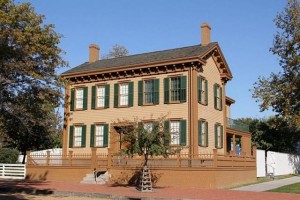
Lincoln Home Springfield, ILAbraham Lincoln, coming from very humble beginnings, believed in the American dream that everyone should have an opportunity to improve their economic and social condition.  With that in mind, in 1844 Lincoln purchased the only house he would ever own.  It was a small house located a short distance from his law offices in downtown Springfield.  In 1856, the house was enlarged to include the second floor to accommodate Abraham and Mary’s growing family of four boys. While Lincoln was campaigning for President, the house became a place for numerous visitors and political gatherings.  After winning the election and becoming the 16th President of the United States, the house was the site of a grand farewell reception.  Before leaving for Washington D.C. in 1861, the Lincolns put the house up for rent and sold most of their furnishings.
After Lincoln’s tragic death, Mary never returned to live in their Springfield home and moved instead to Chicago with her two remaining sons, Robert and Tad.  When Robert married in 1868, Mary and Tad went to Europe on an extended trip aboard, Tad died in 1871. Mary’s mental health, always questionable, rapidly deteriorated and Robert became increasingly concerned.  In 1875, with Robert’s urging, the courts declared Mary insane and she was sent to the Bellevue Nursing Home in Batavia, Illinois.  This news shocked the nation and Robert and his mother became estranged.  A few months after being committed, she was released into the care of her sister in Springfield. Quickly the courts ruled that she had regained her sanity.  Mary traveled to Europe and stayed mainly in France to visit various health spas.  In 1880, she returned to Springfield for the final time, once again living with her sister.  Mary’s physical health was declining from undiagnosed diabetes and complications.  Robert was able to reconcile with his mother before she died in 1882 at the age of 63.

In 1887, Robert Lincoln donated the family home to the State of Illinois with the stipulation that the house would be well-maintained and opened to the public at no charge.  In 1960, the home was designated a National Historical Landmark.  In 1971, the home and adjacent four block residential area became a National Historical Site and administrated by the National Park Service.  Guided tours for the Lincoln Home are free and the timed tickets are available at the Visitor Center.

Additional information can be found at the National Park Services web site at www.nps.gov/liho/index.htm.

Lincoln Tomb

After Abraham Lincoln’s death in 1865, a group of Springfield citizens immediately sought permission from Mary Lincoln to arrange not only the funeral and burial but also to raise funds to build a memorial to honor the 16th President at Oak Ridge Cemetery.  A funeral train consisting of nine special railroad cars carried the body of Lincoln back to Springfield, Illinois.  Mary remained in Washington D.C., too distraught to make the trip. The funeral train took a northern route leaving Washington D.C. with stops in Baltimore, Philadelphia, New York, Albany, Buffalo, Cleveland, Columbus, Indianapolis, and Chicago, before finally arriving in Springfield 19 days after the night of the assassination and having traveled almost 1,700 miles.  Once the funeral train arrived in Springfield, Lincoln’s coffin was transferred to the Illinois State Capitol where it lay-in-state for one night.  After the funeral the coffin was placed into a receiving vault, then as construction began on the tomb and memorial it was moved to a temporary vault further up the hill.  Over the next 30 years, the coffin was moved 15 more times, almost stolen in 1876, before Lincoln eventually reached his final resting place in 1901.

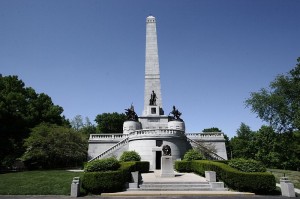
The Lincoln Tomb is in the center of a 12 acre plot in Oak Ridge Cemetery.  The rectangular base of the memorial is made of granite with a 117 foot obelisk and a semicircular entrance way. Four separate flights of stairs exit onto an elevated terrace.  This terrace area is now closed to the public for safety reasons.  On the walls of base for the obelisk are 37 stone shields with the names engraved of the states at the time of Lincoln tomb was built.  The shields are connected by raised bands symbolically representing an unbroken circle and the reunited states after the Civil War.  Four bronze statues representing the infantry, navy, artillery and cavalry are placed at each corner of the base.

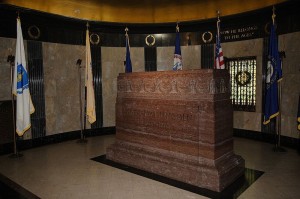
Licoln's Tomb exterior     Lincoln's Tomb interior

Entering the interior of the memorial, there is a rotunda, a burial room and connecting corridors.  The first room is the rotunda which serves as an entrance foyer.  As visitors enter the rotunda there is a small replica of the Lincoln Memorial statue located in Washington, D.C. and this dominates the entrance foyer.  Around the room 16 marble columns are separated by marble panels.  The columns represent Lincoln and the 15 presidents who preceded him.  Corridors from the rotunda lead to the burial room at the rear of the memorial.  Located along the corridors are a series of eight statues depicting various times of Lincoln’s life.  In the center of the burial room stands red marble cenotaph engraved with Lincoln’s name, the years he lived and on the wall behind is the inscription “Now he belongs to the ages”.  (A cenotaph is an “empty tomb” or a monument erected in honor of a person whose remains are elsewhere.  In the case of Lincoln – he is actually buried in a cement vault 10 feet below the surface of the burial room.)  Along the south wall of the burial are four crypts containing the remains of Mrs. Lincoln and three of Lincoln’s four sons: Edward, William (Willie) and Thomas (Tad).  Their eldest son, Robert, is buried in Arlington National Cemetery just outside of Washington D.C.

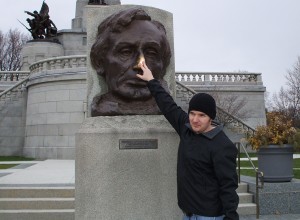
Lincoln's Tomb 1TRAVEL NOTE:  At the front of the Lincoln Tomb there is a bronze statue of Lincoln’s head. This statue was done by Gutzon Borglum, the man who is famous for Mount Rushmore.  You will notice from the photo to the right that shows my son, visitors often stop to rub the nose for good luck.

For more information on the Lincoln Tomb and War Memorials please refer to the Illinois Historic Preservation Agency website at www.illinoishistory.gov/hs/lincoln_tomb.htm.

For additional Abraham Lincoln sites and landmarks in other parts of the United States, please click on the link to New Salem, IL for information about where Lincoln lived during his early adult years and the Lincoln Memorial which is located in Washington, D.C.